Monday, 23 May 2016

Task 2 - Ideas Generation - AS2

Idea One

FORM: Realist Narrative 

STYLE: Humour

CONTEXT: This is set in a school when a student needs help and puts his hand up. The teacher comes to offer help and the student screws their face because the teacher has bad breath. The teacher then notices the bad breath and pops a rectangle chewing gum into his/her mouth and then all of sudden all the kids want his/her help.

TARGET AUDIENCE: Everyone.

WHY IT APPEALS TO AUDIENCE: No one knows when their breath smells and children always tell the truth, so to avoid ay embarrassment that everyone is vulnerable to they should just eat a chewing gum.

USP: Flavour is intense, offers a long and instant solution to bad breath.

STORYBOARD: 


Idea Two

FORM: Anti-Realist Narrative

STYLE: Surrealism 

CONTEXT: There will be a dad making his kids take a taste test to try his new chewing gum. They will eat the other ones and when they get to their dads one their whole world changes, their taste buds explode they can see the future, they get a high off of the chewing gym because it tastes so nice.

TARGET AUDIENCE: Everyone.

WHY IT APPEALS TO AUDIENCE: Everyone needs chewing gum once in their lives. So they would want one that change their life for a long period of time.

USP: Intense flavour, lasts for a long time.

STORYBOARD: 


Monday, 25 April 2016

Task 1 B - Market Research - AS2


Market Research


These are the most popular brands within the chewing gum industry. Within my audience research, these are the chewing gums that were mentioned; even if it was just the once.


Adverts


This extra advertisement is in the style of intertextuality because when you watch it, it is as if you are watching a movie. There is a lot of emotions behind the advert, mostly love and it is in the form of realist narrative due to it being relatable to real life. This is effective in showing the ways that one can enjoy chewing gum throughout different aspects of life, whether you share that with someone or not. It is said that certain smells, tastes and sounds can bring out memories. it seems as though Extra was trying to appeal to that theory. i noticed that this advert didn't use any famous faces,  and that's probably to be able to interact with the many of us that aren't famous to show them that the smallest gesture (a piece of chewing gum) can bloom into many other things; it opens doors. Giving people hope in a way. 


This advert is effective because its only 4 seconds long and because it is short and snappy and it includes the company's 4 word slogan 'eat drink chew, Extra' which makes the audience process it due to it being so short; makes it easier to remember. 


This airways advert is in the style of humour, the tune the people are blowing would be humorous to some. Using this style is effective because if you make people laugh then it leaves them in a good mood. If you have a positive effect on someones mood then they are more likely to enjoy the things that are included within the advert therefore selling the product at hand.

Tuesday, 23 February 2016

Task 1 B - Target Audience Research - AS2


Target Audience Research

Focus Group


Quantitative - Survey Monkey


I have created a survey on chewing gum and collected feedback from my peers. I am now aware
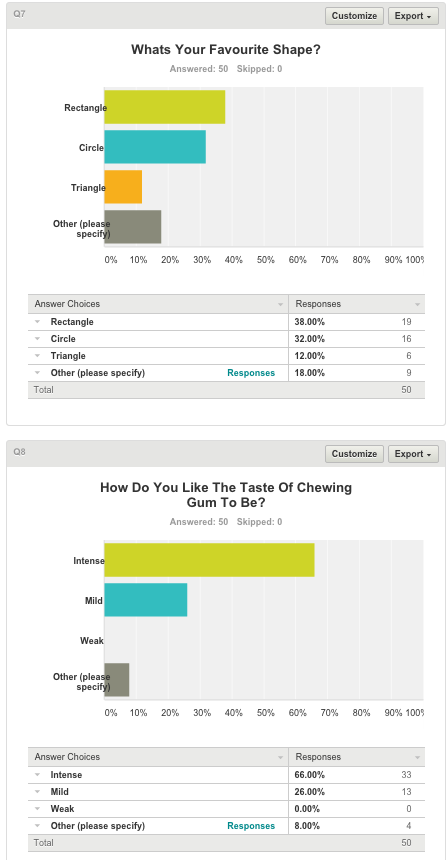
of the best methods and techniques required to sell my product. From my survey i know that 70% of the people i asked buy their chewing gum either everyday or multiple times a week which suggests that the consumption and demand of chewing gum is very high meaning that my product would sell efficiently. My second question asks 'What brand of chewing gum do you purchase?" and found that 73.33% bought extra when they buy chewing gum. My third question asked 'What is your gender?" and i found that 56.14% were male. This shows that more males buy chewing gum than females. My fourth question was "What is your favourite flavour?" and 29.31% said ice. My fifth question was "What is your favourite colour?" and 29.31% said that their favourite colour is blue. My sixth question was "How old are you?" and found that 75% of people that answered the question were between the ages of 12-17.  My seventh question was "What is your favourite shape?" and found that 36.67% of people said that rectangle was their favourite shape. My eighth question was "How do you like the taste of chewing gum to be?" and 63.33% said they like their chewing gum to be intense. My ninth question was "how much would you be willing to pay for a standard pack of chewing gum?" and 58.33% said that they would pay 50p for a pack of chewing gum and my tenth question, which was my last question, was "usually, how long does your chewing gum taste last?" and the highest result back was more than 10 minutes with 39.34%. All of the results i have stated above were the highest results that i had received from each question.


Tuesday, 2 February 2016

Task 1 A - The Language of Advertising - AS2

Different Types of Magazines

Within the advertising and magazine industry, there are various genres that are published which have different target audiences, some examples of magazines are shown below, you can see the different techniques that they use on each cover and how it applies specifically to the genre.

                                           Sport                                                      Food


                                      Lifestyle                                                 Music
                           

                                            Teen                                                         Fitness


News                                                         Fashion


Why Are Language Devices Used?

Language devices such as:

Mode of address - This is the ways the text address the reader, for example; if they say 'you' they're addressing you, making the audience feel subjective to the author and grabs the attention. This is how the media interacts with their audience.

Alliteration - This is the occurrence of the same sound or letter; this is used to focus the attention on a particular section of text, it creates rhythm and emphasises certain words.

Power of 3 - This is used as humour because things that come in 3 are typically a funny gesture. It is an effective way of getting information across because helps the audience remember it.

Colloquial - This is used to set a different tone, its usually uses an informal and more personal tone which engages the audience even more because you're instantly connecting with your readers.

Emotive language - This is used to create emotion among the readers; words can provoke either positive or negative responses depending on what the topic of the magazine is.

Monosyllabic - These words are usually short and snappy therefore are effective to the reader.

Personal pronouns - Used to emphasise what the character is feeling, it shows that the person is sharing personal information with the audience.

Abbreviation - This is used to shorten a word or phrase so that it sounds more exciting.

Rhetorical questions - This is used to allow the reader to make their own decisions and by doing this it also emphasises the point that they're trying to make because you have to process an answer yourself.

Exclamation marks - These are used to display a strong or urgent feeling; they also express excitement because they add emphasis.

Repetition - This is used to reinforce a key idea and drive home a message to a reader.

Rhyme - This helps makes phrases more catchy and interesting which captures the readers attention. It also helps the phrase become well known because they may say it in casual conversation.

All of these techniques are used on the majority of magazine covers, but why?
I just used one as an example. The fact that I asked you a question and as my audience, it intrigued you in to thinking about the answer. That is the primary reason as to why magazine publishers use a combination of all of these techniques; to engage their audience and get them to want to read on further. This then maximises the company's profits if more people are buying the magazine and ultimately, the two goals both are based on popularity and profits.

Analyse Glamour Magazine


This glamour magazine is a good example because it uses a lot of the language techniques.
This Look magazine used exclamation marks in the quote 'Amp Up Your Look!'. There's also repetition within that sentence because the magazine is called 'Look' and it refers back to its name to engage their audience and keep them aware of what the magazine is called. The magazine also uses colloquial language, rhyme, personal pronouns and a rhetorical question all in one quote; "Are You A Rinsta Or A Finsta?". Due to the direct invitation of speech used ('You') it makes the audience feel somewhat special as if the magazine is talking directly to them. Abbreviations are used on the magazine cover where it says 'It's LBD Season!'. LBD is an abbreviation for little black dress and usually only people interested in fashion would understand this term which shows the magazine publishers reaching out to their target audience. The other techniques this magazine cover uses are: alliteration, power of 3, emotive language and monosyllabic. The example for alliteration is 'Best style & Beauty hacks' the repetition of the 'B' makes it easy for the words to be remembered as they roll easily off of the tongue. An example for power of 3 and monosyllabic is 'NYC, London, Milan' 3 well known places of fashion which also relates to the target audience. The last example would be for emotive language; 'The heath scare that's changed my life'. This changes the whole mood of the magazine, showing the audience that there is other things that go on in the world that would affect people.

Magazine of Choice


This vogue magazine demonstrates many advertising techniques such as: mode of address; the magazine cover says 'Dress up with YOUR hair'. This is directly addressing the audience and making it seem as if the magazine was made specifically for them. Alliteration; 'Fashions most fabulous florist' the repetition of the 'F's' emphasise the point that they're trying to make. This may be an opportunity to get someone's name out into the industry which is why they're trying to make their point stand out. Power of 3; 'Princesses, dresses and silver shoes' this was put in a group of 3 because they all relate to one another, there's also a slight rhyme with the endings of the words (es). Monosyllabic; the actual name of the magazine is monosyllabic 'VOGUE' and that's partly why the magazine is so famous because it has one syllable that just rolls of the tongue. Exclamation marks: 'Oh so pretty!' notice that this is one of the first things you see when you look at the magazine, not only because of the exclamation mark but because it is in a large font which makes the text stand out.  Rhyme; 'More dash than cash' - this is a catchy saying that anyone can easily remember, it is also slightly colloquial and they would also remember where they saw it which is why they used it on their magazine, they want to make their product unique and memorable to the customer therefore that's why they use all of these techniques to interest the audience and keep them interested. Baring in mind this is just the front cover and as the saying goes 'first impressions count'.


Friday, 15 January 2016

Task 9 - Referencing - AS1

Referencing

The Media: An Introduction Edited by Adam Briggs and Paul Cobley. “Chapter 17 Audience research by Ray Kent”. Longman 2002. ISBN 0-582-42346-5

* “The Media Magazine. The English and Media Centre.” “How I make things. Garth Jennings on making a TV commercial”. Issue 39 / February 2012. ISSN 1478-8616


“The Media Magazine. The English and Media Centre.” “Adjudicating ads. Claire Forbes”.  Issue 23 / February 2008. ISSN 1478-8616


The Media Students Book 4th Edition”, “Chapter 9 Advertising and Branding”: Gill Branston and Roy Stafford: Routledge 2007: ISBN 0-415-37143-0


Top 30 Programmes :  Broadcasters Audience Research Board http://www.barb.co.uk/ www.barb.co.uk/viewing


How we do what we do”:  Broadcasters Audience Research Board  http://www.barb.co.uk/ www.barb.co.uk/viewing


Viewing data”:  Broadcasters Audience Research Board http://www.barb.co.uk/ www.barb.co.uk/viewing


Five controversial TV and internet ads – video” - The Guardian www.theguardian.com › News › Media › Ad break‎ : 


Advertising Standards Authority”: https://www.asa.org.uk/


 “AS Media Studies: The Essential Introduction Second Edfition. Philip Rayner, Peter wall and Stephen Kruger.” “Part 4: Three Case Studies. Case Study 2: advertising and marketing.” Routledge 2005. ISBN 0-415-32966-3


 “Advertising | How to Advertise on Channel 4 and its platforms”: http://www.channel4sales.com/advertising.

https://www.youtube.com/


Task 8 - Sources Of Information In Advertising - AS1


Where You Can Find Information on Television Ratings and Why This Information Is Useful

You can find information on television ratings from reliable sources such as BARB. BARB stands for 'Broadcasters' audience research board' and around 11,500 individuals have BARB within their homes and this records what programmes they watch and who is in the room watching. The data is collected overnight and ratings are published at 9:30 AM the following morning for use by TV stations and advertising industries. This information is useful because it allows the industry to focus on the not so popular shows to boost publicity and hopefully boost their ratings. The reason some people may not be watching some shows is because they might not know that they're showing so knowing the ratings can help with this problem. Also it shows key strengths within the industry and it gives shows objectives, I.E getting a certain rating morning and if it drops, to change their regime.

What A Programme Profiles Is and Why An Advertising Company Might Find One Useful

Programme profiles is a breakdown of who watches the programme. This is useful to an advertiser because it allows them to target adverts to specific programmes. For example, the majority of people that would watch Downtown Abbey are women 50+ therefore the adverts shows during the breaks would be ones that are aimed to that audience. Another example would be if the a football match was on. The majority of people that watch the football are men therefore, the adverts that would show in the break would be things such as: Gillette, Razors, Nivea Men etc.

What A Rate Card Is and Why It Is Useful For An Advertising Company (ITV Media)

A rate card is how much it costs to put an advert on. Rates depend on hours, for example 'Coronation Street' is much more expensive than other programmes that are shown at a earlier, unsocial hour. This is useful for an advertising company because it creates competition in the sense that not all advertising companies can afford to pay the rates for their advertisement which allows other companies to then swoop in and take the slot.


What Information Can Be Found In An Online Advertisers' Information Packs (Channel4sales&ITV)

Both of these popular TV stations show the advertising industry what is new to their channel which gives advertisers the choice and the understanding of what audiences would be watching which they can then compare to what they want their target audiences are. They also include sponsorship and why they should choose their channel. Sponsorships are useful to advisors because it brings in money for the advertisers; they get money for trying to make money, basically. They also get publicity which makes whatever they're advertising more popular. 

Task 7 - Audience Research - AS1

Audience Research

Throughout the media industry the audience and their desires, preferences and opinions plays an important role. The entire media texts are made with an audience in mind. The producers can even make some money out of the audience, not always; sometimes. Therefore, it is important to understand what happens when an audience is introduced to a media text. Also, advertisers want to sell their products, so when they study their audience they will have a better understanding in trying to connect their product with the audience. That is why advertising industries gather information before they start producing a new advertising campaign. There are four types of audience research; descriptive, analytical, predictive and tracking
In the advertising industry audiences are carefully studied so that advertisers can understand exactly how to sell to them.


Audiences are divided and labelled into the following categories:

Standard Occupational Classification (sometimes called social grade by advertising companies)

This is a method of dividing and labelling consists of using letter codes to show their income bracket. I.E - A - Bankers, lawyers, doctors and other highly paid professions. B - teachers, graphic designers. C - nurses, office supervisors. D - skilled workers, tradesperson. E - semi/unskilled manual workers and finally F - students, unemployed, pensioners and casual workers. It is important to divide the audience into these letter codes so researchers give the correct information that is relevant to each profession.

Psychographics (a common attitude)

This method is when you divide audiences depending on the common attitudes within the audience. This includes: personality, values, interests, attitudes and lifestyles. Within this category, the publishers focus on the audiences interests activities and opinions. This is important again so the publishers know their audiences and understand them in a deeper way.

Geodemographics (where they live)

This is another method on how to get a clear target audience. This is when the publisher focuses on where the audience lives and is based on two rules. 1) People that live within the same area are more likely to share the same characteristics rather than two people from two different towns and 2) two neighbourhoods can be placed within 1 category because although they live in different areas, they may still have similar personalities. This is important to publishers because they could publish different adverts in different towns depending on the attitudes of them.

Age

Age is important when it comes to audiences because interests and occupations depend on the persons age. For example, 16 year olds aren't going to care about gardening, however, people that are 50+ are more likely to have a greater interest within the matter.

Gender

This category is important, although some people may like to categorise some aspects as sexist; it is the truth. Girls and boys have different interests, for example, girls would be more interested in makeup rather than football and vice versa. That is why it is important for publishers so they understand the generation and interests of the generation at hand.


How Information About Audiences Is Gathered By Advertising Companies

Information about audiences is gathered through 4 basic types of research. These 4 types are: descriptive research; describes the audiences characteristics. Analytical research; understands 'how' 'why' and 'what' motivates the audience. Predictive research; considers 'what if' situations and questions the audience. Tracking research; long-term research.

Usually a audience research agency, such as BARB (Broadcasters Audience Research Board) sample a population and monitor them over a period of 7 days. The data that was received is then spread across the whole population, based on percentage sample. All individuals ages 4+ are measured by BARB to get an overall idea of what to publish. The advertising agency pays the television station a certain amount of money based on its viewers.

BARB research:


Ofcom research:


Ofcom carries out research on the markets that they regulate. This includes things like their communications market report, annual report into the consumer experience, etc. Their research helps keep others informed on the new technology developments and the impact on the things that their markets regulate such as: TV, radio and on demand, telecoms, internet and many more.

Audience measurement panel is how many people are within the audience. Whether that be how many people are watching TV, listening to the radio or reading the newspaper. This helps producers understand their audience because if they're losing viewers they will change what they're advertising in order to regain interest in people. However, The Panel is just a representation, it's not exactly accurate because each person represents a number of people in the universe (particular country/area) and if 1 person represents the universe that means that every person represents 10,000 people which isn't correct. In contrast, it is impossible to interview every single person on the earth to get an exact preference so therefore, it is the most accurate way to go about it. if you want a representation of the world.